
Homemade Pizza
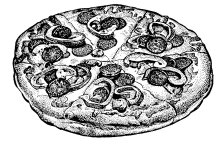
Begin by preparing the crust from one of the recipes above. While the dough is resting, make the sauce, or use canned spaghetti sauce to save time. By the time the sauce is done, the dough will be ready to press in the pan, and pre-bake (see the Pizza Crust Recipe for greater detail). After pre-baking, the crust is ready for sauce, cheese and toppings, and a quick trip to the oven to heat everything evenly. Homemade pizza is so good, and so easy after you’ve made it a couple times, that you will never spend twenty five dollars on take out or delivery again!
Tips and Tricks
Pizza is an incredibly versatile food with great kid appeal. Home made pizza differs a little bit from the Delivery and Frozen varieties. Made at home, pizza is less greasy, the flavor is usually fresher, and the texture of the crust is a little different, to my taste buds, much better. There are a plethora of choices for inexpensive toppings at home, and we’ll get to them in a minute. In order to explain this as simply as I can though, I will start at the bottom and work my way up to the toppings. First comes the:
Pans: You don’t need round pizza pans to make homemade pizza. Any ordinary pan will work just as well. Pizza dough doesn’t know what shape it is supposed to be, so you can use this to your advantage, making your pizza in a combination of pans you already own. With that said, I must confess that I use round pizza pans which I found on sale once for $2 a piece. My children had been coveting round pizza for so long, at such acute decibels of screeching, that I succumbed to temptation. They are about 16 inches in diameter. This size pan is the equivalent of a large pizza purchased from the store. I almost always make two at a time so I will have enough leftovers for lunch boxes the next day. My recipes are geared for two 16-inch round pizzas, or two 9 by 13-inch rectangular baking pans. Just use whatever sized pans you find lurking in the cabinet. If you are making individual pizzas for a bevy of boy scouts or a gaggle of girl scouts, these recipes will make about 8 pie or cake pans worth.
Crust: My best pizza crust recipe is linked here and above. It is pretty easy to prepare, and makes a very tasty crust. Make sure you rest the dough between kneading it and pressing it into the pan. This relaxes the protein in the dough and makes it easier to roll out. Also note that I pre-bake the prepared crust, before topping it with the sauce or the toppings. This ensures that the crust will be cooked all the way through, resulting in a crispy crust, instead of a soggy one. If you don’t want to make your own dough from scratch, frozen bread dough may be used instead. Two loaves of frozen bread dough can be taken out to thaw in the morning. They will be ready to press into cookie sheets or baking pans by evening. Be sure to prebake the frozen bread-dough crust, especially if it is thick. If you like a crispy crust for gnawing on after eating the rest of the pizza, try this trick. Use a pastry brush, or small spoon to dribble a little oil around the outer edge of the crust right before baking the pizza. I fill a clean ketchup bottle with oil and dribble it though the squirty spout onto the edges of the pizza. This does something exotic and delicious to the crust that is difficult to explain, but tastes very good. I like it so much; I always prepare it this way.
Pizza Sauce: Above and here you will find a link to my favorite Italian Tomato Sauce . My recipe makes a little over a quart, plenty enough for up to four 16-inch pizzas. The recipe begins by sautéing onions and garlic in a little oil. This makes a chunky and slightly rich sauce, which is very good on pizza. If you want something a little simpler try this: In a medium bowl combine 2 – 15 oz cans of tomato sauce with 1-tsp basil; 1/2-tsp oregano; 1/2-tsp garlic powder; 1-tsp sugar, 1-tsp onion powder & 1/2-tsp salt. Stir it up nicely. Add a spoonful of oil if you like, for flavor, and use it to make the pizzas. Alternatively, canned spaghetti sauce may be used if desired. One 24-ounce can will be enough to generously cover two pizzas.
Cheese: Mozzarella is traditional for pizza, but other cheeses can add variety. Cheddar, Monterey Jack, and Provolone among others are good in combination with Mozzarella. For a plain cheese pizza, spread sauce on the crust after pre-baking it. Scatter about two cups of cheese on top of the sauce, and then sprinkle with a few shakes of Parmesan. The final sprinkling with Parmesan cooks up very nicely, and makes for a tastier pizza. This is one of the secrets to an extra good finished product. For cheese pizza I usually use 1-1/2 cups of Mozzarella and 1/2-cup of Cheddar cheese. I used to use a lot more cheese on my pizza, closer to 3 or 4-cups per 16-inch pizza. Then one day I didn’t have much cheese in the fridge so I was forced to use less by circumstances. The pizza turned out much nicer with less cheese. Since then, I have made it my custom to use no more than 2-cups of cheese on a round 16″ pizza, or about 3-cups on a large cookie sheet. Probably not everyone is as much of a cheese glutton as I am, and has figured this one out already.
Vegetarian Toppings: Many types of vegetables are delicious on pizza. Green Peppers, Green & Black Olives, Mushrooms, Onions, Sliced Tomatoes, Green Chilies, and Hot Peppers, are the most common. Fresh vegetables should be thinly sliced or finely chopped before arranging on top of the cheese. Some fresh vegetables, like peppers, onions and mushrooms, can be sauteed into the sauce if desired, making them more savory for consumption. Canned items should be very well drained, and even rinsed if you think it necessary. I buy canned mushroom stems & pieces in 4 ounce cans for fifty cents a piece at my local super store. One can, well drained, is enough to generously cover a 16″ pizza. Minced black olives are available inexpensively in small cans too, and I often use them on vegetarian pizzas. The kids hate them, but adults adore them. Fresh tomatoes, thinly sliced are very nice if you drizzle them with a tiny bit of oil before baking. They lend a juicy and toothsome quality to a vegetarian pizza. Hot peppers are available from very mild Green Chili Peppers, to fiery Jalapenos, which should be used sparingly, even by hot pepper lovers. Both are usually available in the mexican food section of the supermarket. I am very fond of canned pineapple chunks on my pizza, especially when paired with ham or bacon toppings. Not everyone can go for fruit on their pizzas though, so let your own family’s taste buds be your guide. If you decide to use them, then drain them well and scatter about a cup of pineapple chunks over the cheese before baking. They are sweet andcontrast nicely with jalepenos for a vegetarian delight.
Meat Toppings: Many types of meat products are good on pizza. I have used most meats, to good advantage on pizza. Ground Beef or Turkey is a favorite. Fry it loose in a skillet and drain off all the fat. Then spoon it over the cheese. Half a pound of ground beef is enough for one 16-inch pizza. A pound is enough for a large cookie sheet pizza. Bulk Pork Sausage may be prepared the same way. As with the beef, be certain to cook it all the way through. Pork Sausage is Fred’s favorite topping on pizza, besides pepperoni, which I seldom buy because of the cost. Prepared meats, like baloney, hotdogs, bacon and smoked sausage are good on pizza too. Baloney is best cut into triangles and fried before putting on the pizza. Hotdogs and Smoked Sausage should be sliced thinly and scattered about the surface of the cheese. Two to three hotdogs, or a third of a pound of smoked sausage will be enough for a 16-inch pizza, depending on how thinly you slice them. Six or eight slices of Bacon are enough for one 16-inch pizza. Fry the bacon crisp and then crumble it onto the pizza. Other items you might not have thought of are tuna packed in oil (and well drained) and canned anchovies. I am very fond of anchovies, so this is a favorite of mind. Tuna is especially good with black olives. One can is enough for a 16-inch pizza. Ham makes a good topping too. Sliced Sandwich Ham is best cut into thin strips and fried before putting on the pizza. Baked or Canned Hams should be cut up finely and scattered over the cheese before baking.
Cooking: It is difficult to give an exact time for how long your pizzas should cook during the final baking process. Many factors go into determining this. The size of the pan, the quantity and density of your toppings, the temperature of the toppings and many other variables contribute to the length of time it takes for the pizza to cook completely. Assuming you follow my recommendations for pre-baking the crust, the fully prepared pizza should cook in about 12 to 20 minutes. A large thick 9 by 13-inch pizza with a pound of cooked meat on it, and 3/4-pound of cheese may take as long as half an hour though, so use your good sense to help you determine when it is done. Plain cheese pizzas cook the fastest, usually in about 10 minutes or so. The clue I use most often is the color of the crust, and the bubbly-ness of the cheese. When the cheese it completely melted, slightly brown in a couple of spots, and bubbling in a sort of volcanic mass, then the pizza is done. I usually bake my pizza at about 400 or 425°. The high temperature makes the crust a little lighter, and the toppings are less likely to over cook, in my opinion. If the pizza seems done, take it out and stab it in the center with a fork. Peer down at the crust, the toppings and the cheese. If the center appears cooked all the way through, then you can eat it. If you aren’t sure, or if it still seems a little raw in the center, then place it back in the oven and test it again in a few minutes. If the edges are burning, go ahead and take it out and eat it as is. Otherwise, bake it until it meets your standards of completion.
Cost: Cheese pizza, using my crust recipe and sauce recipe and assuming the cheese is purchased as cheaply as possible, winds up costing well under $2 per 16-inch pizza. It can be as cheap as $1.50 per pizza if all the ingredients are purchased on sale. Mushrooms, olives and other vegetables increase the cost about 40 to 50¢, depending on their purchase price. The meat toppings suggested above add between 30 and 50¢ (per pizza) to the final cost, with hot dogs and baloney being at the low end, and sausage, ground beef and ham being at the high end. All said, exotic pizzas, with lots of fancy toppings can be made for about $3 a piece. Or to put it another way, for the price of one medium sized frozen gourmet cheese pizza from the store, you can prepare two large pizzas with the works at home.

Bye Bye Delivery!
To support the blog, check out the HBHW eBooks available on Amazon. Thank you!
Disclosure: Some of the links below are affilate links, meaning, at no additional cost to you, I will earn a commission if you click through and make a purchase.
